
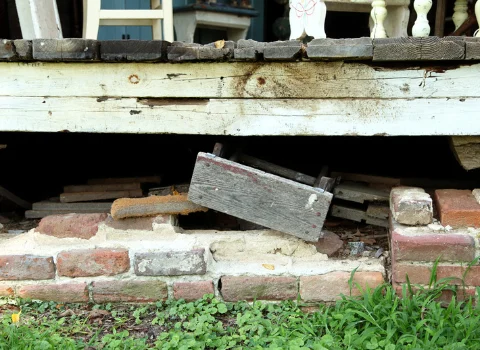
A crack in the basement wall. A floor that slopes toward the kitchen. Doors that stick in one season and swing open in the next. If you’ve noticed any of these in your Rhode Island house, you’ve probably also wondered whether anyone will buy it without a repair bill attached.
They will. Selling a house with foundation issues mostly depends on who’s buying and how they’re paying. A buyer with a mortgage needs the foundation fixed or explained before the bank will lend. A cash buyer doesn’t. We Pay More Properties buys Rhode Island houses with cracked, bowed, wet, and settling foundations exactly as they stand, and every offer comes with the $10,000 More Guarantee: show us a written cash offer from a valid home-buying company, and we’ll beat it by at least $10,000.
Why Foundation Trouble Is So Common in Rhode Island
A lot of Rhode Island’s housing went up long before modern poured-concrete foundations were standard. Walk into the basement of a 1900s triple-decker in Pawtucket or a mill house in Woonsocket or Central Falls and you’ll often find fieldstone or brick walls held together with old lime mortar. Those foundations can last a very long time, but the mortar washes out, stones shift, and water finds its way in.
Add New England freeze-and-thaw cycles, coastal neighborhoods in Warwick and Narragansett with high water tables, and decades of gutters dumping water against the house, and you get the problems inspectors flag most often here:
- Wet or damp basements with efflorescence (white mineral crust) on the walls.
- Crumbling mortar and loose stones in fieldstone or brick foundations.
- Horizontal cracks or bowing in concrete-block walls, usually from soil and water pressure.
- Rotted sill plates where the wooden frame sits on the foundation.
- Settlement that shows up as sloping floors, cracked plaster, and doors that won’t latch.
Not all of these are serious. A hairline vertical crack in poured concrete is often cosmetic. A bowing block wall or a rotted sill is not. The problem for a seller is that, on paper, a buyer’s inspector reports them all. None of that makes a house unsellable; it just makes it a house a traditional buyer’s lender won’t touch until repairs are done. If the property also has an open code violation alongside the structural issue, our guide to selling a house with code violations in Rhode Island walks through that side of it.
What You Have to Disclose in Rhode Island
Rhode Island’s Real Estate Sales Disclosure Act requires most sellers to give the buyer a written disclosure form before the buyer signs a purchase agreement. Under R.I. Gen. Laws § 5-20.8-2, the form has to list every deficient condition you actually know about, and it has specific lines for structural conditions, moisture penetration, and the basement (seepage, leaks, and cracks). Selling as-is doesn’t change that, and the rule covers cash sales too. The form still has to be delivered, and under § 5-20.8-5 each violation carries a civil penalty of up to $1,000. You can read the Real Estate Sales Disclosure Act on the state legislature’s site.
The rule is simple: if you know about it, disclose it. If you’ve had a contractor or engineer look at the foundation, mention it. Hiding a known structural problem is the fastest way to turn a sale into a lawsuit, and it doesn’t work anyway, because a buyer’s inspector will usually find it. Disclosing it doesn’t lower what a cash buyer is willing to pay the way it would scare off a traditional buyer mid-contract; we price the house with the defect in mind, not after you’ve accepted an offer.
How Foundation Problems Derail a Traditional Sale
The inspection
Most buyers make their offer subject to a home inspection. When the report mentions a foundation issue, the inspector almost always recommends a structural engineer. That adds another visit, another report, and another week or two to your timeline.
The lender
Lenders want to know the house is structurally sound before they fund the loan. Under HUD’s FHA handbook, an FHA appraiser has to examine the foundation for readily observable structural problems, report any repairs or inspections that are needed, and tell the lender if the basement shows dampness or obvious structural trouble. Major cracks, bowing or leaning walls, and uneven floors are the kind of thing that gets written up. From there, the appraisal may come back “subject to” an engineer’s report or a completed repair, and conventional lenders may ask for the same. Until that’s resolved, the loan doesn’t close.
That wait comes on top of an already slow timeline. Realtor.com data published by the St. Louis Fed showed a median of 37 days on market for Rhode Island listings in August 2026, and the lender’s closing period comes after that. An unresolved foundation issue can push you well past it, sometimes by months, while financed buyers keep walking away after their appraisal comes back flagged.
The renegotiation
Once the engineer’s report comes in, the buyer comes back with a number. That could be a price reduction, a repair credit, or a demand that you do the work before closing. Foundation repair estimates tend to be large and vary widely between contractors, and buyers almost always lead with the highest quote.
Insurance
Standard homeowners policies don’t pay for damage that comes from lack of maintenance, and they exclude several kinds of earth movement, such as landslides and sinkholes, according to the Insurance Information Institute. A foundation that has been slowly settling for decades usually isn’t a covered loss. So the buyer can’t count on insurance to cover a problem that already exists, and neither can you. That’s one more reason buyers treat foundation work as a straight deduction from the price.
A cash sale never touches any of this. No appraiser decides your house doesn’t qualify for a loan, no engineer’s report stands between you and closing, and no lender demands repairs before releasing funds.
Do You Need an Engineering Report First?
No. A bank may require one before it will fund a buyer’s loan, but selling to We Pay More doesn’t. If you already have an inspection or an engineer’s report, share it with us; it can help us move faster, but you don’t need one just to sell your house.
What Repairs Cost vs. What a Cash Offer Looks Like
Foundation repairs vary widely. Angi’s 2026 cost guide puts a simple foundation crack repair at $250 to $800, while fixing bowing walls runs $4,000 to $12,000 and correcting a settling house runs $5,000 to $25,000. Major structural work can run well into five figures. Either way, you’d be paying for that work and still doing everything else a traditional sale requires, from cleaning and showings to an agent’s commission, before you ever see a closing date. A cash offer accounts for the condition once, in one number, and you’re done.
There’s also the version of this that costs you even if you never hire a contractor: a house that sits on the market for months because financed buyers keep falling through. Every one of those months still costs you property taxes, insurance, and upkeep on a house you’re trying to leave behind.
Your Three Options
Fix it, then sell
Get an engineer’s report, hire a contractor, pull the permits, and do the work. You’ll have a clean story for buyers and the widest buyer pool. You’ll also spend the money up front, wait for the work to finish, and still pay agent commission at the end. Foundation work done in winter can also take longer, since excavation and concrete pours depend on the weather.
Sell as-is with an agent
You can list the house as-is and disclose the problem. Expect fewer showings, financed buyers whose lenders won’t approve the loan, and offers from investors anyway, just with an agent’s commission in the middle. Our guide on whether to fix up your house or sell as-is in Rhode Island walks through that math in more detail.
Sell directly to a cash buyer
No lender means no appraisal condition. No inspection contingency means no renegotiation two weeks before closing. The foundation is priced into the offer from the start, and that number doesn’t change after an engineer visits. As-is doesn’t mean “as long as it’s not too bad.” It means exactly what it sounds like: we look at the foundation, the walls, the floors, whatever shape they’re in, and build it all into one firm offer.
How We Handle Houses With Foundation Problems
We’ve bought houses with stone foundations that let in water every spring, block walls that had started to lean, and sill plates you could push a screwdriver through. None of those are deal-breakers for us. We look at the house, we price the repair ourselves, and we give you a firm number.
That’s what it means when we say we buy houses as-is across Rhode Island. You don’t hire an engineer. You don’t get three contractor quotes. You don’t pour concrete. A foundation is the clearest example of the repairs you can skip when you sell your home for cash. If speed matters most, our fast cash home-buying process is built to close in about a week.
And the guarantee holds no matter the condition. If another legitimate cash buyer gives you a written offer on your house, cracked foundation and all, we’ll beat it by at least $10,000.
The steps are the same whether the issue is a hairline crack or a wall that needs to be rebuilt:
- Tell us about your home. A short form. Mention the foundation issue and any reports you already have.
- Get your cash offer. Firm and in writing, within 24–48 hours, after a quick walk-through. One number that already accounts for the foundation’s condition.
- Pick your closing date. As soon as 7 days, or later if you need more time.
- Get paid. Sign at the title company. No commissions, no fees, no repair punch list, no re-negotiation.
Why Rhode Island Sellers Choose We Pay More
The Rhode Island market has moved fast the last couple of years. The Rhode Island Association of Realtors put the single-family median sale price at $499,900 for all of 2025 and at $544,000 in August 2026. At prices like that, a house that can’t pass a lender’s appraisal is at a real disadvantage, sometimes sitting unsold for months longer while a seller looks for a buyer who’ll take it as-is. We close in as fast as 7 days, with no agent commissions, no repair costs, and no fees out of your proceeds.
We’re a Rhode Island company with offices in Providence and Cranston, not a national call center. We already know which neighborhoods have older housing stock and foundation quirks, so there’s nothing to explain, and we can usually see your house within a few days, whether it’s in Central Falls, Coventry, or Bristol.
FAQ: Selling a House With Foundation Problems in Rhode Island
Can you sell a house with foundation problems in Rhode Island?
Yes. You have to disclose the problems you know about on Rhode Island’s seller disclosure form. You don’t have to fix them before you sell. It just changes who your realistic buyer is: a financed buyer’s lender may require repairs first, and a cash buyer like We Pay More doesn’t.
Will a buyer get a mortgage on a house with a bad foundation?
Often not until the problem is repaired or an engineer signs off. Lenders want the house to be structurally sound before they fund a loan, and that’s where most foundation-related sales stall.
Do I need a structural engineer’s report before I sell?
Not to sell to us. A traditional buyer will probably ask for one. If you already have a report, it helps any buyer price the house accurately, and you’re welcome to share it with us.
Is a wet basement a foundation problem?
Sometimes. Water coming through fieldstone or block walls can wear down mortar and rot the sill over time. Even when it’s just a drainage issue, buyers and inspectors will treat it as a foundation concern.
How does We Pay More price a house with foundation damage?
We factor the house’s full condition into one firm offer up front. There’s no repair-credit renegotiation after an inspection. Any buyer will account for the repair; what changes with us is that you don’t pay for it, you don’t wait for it, and we’ll beat any other written cash offer from a legitimate home-buying company by at least $10,000.
How fast can I close?
As fast as 7 days once you accept an offer. You can also pick a later date if you need more time.
Get a Firm Cash Offer, Foundation and All
A cracked foundation or a sloping floor doesn’t have to mean months of repairs before you can sell. Tell us about your house through the form on this page or call (844) 937-2966. You’ll have a written cash offer within 24–48 hours, you pick the closing date, and we’ll beat any written cash offer from a valid home-buying company by at least $10,000. No engineers, no contractors, no surprises at closing.